
Anatomical Foundations of Thread Lifting: Essential Structures for Safe & Effective Results
- Berta Beaute co.
- November 19, 2025
- 3:09 AM
- 0 comments
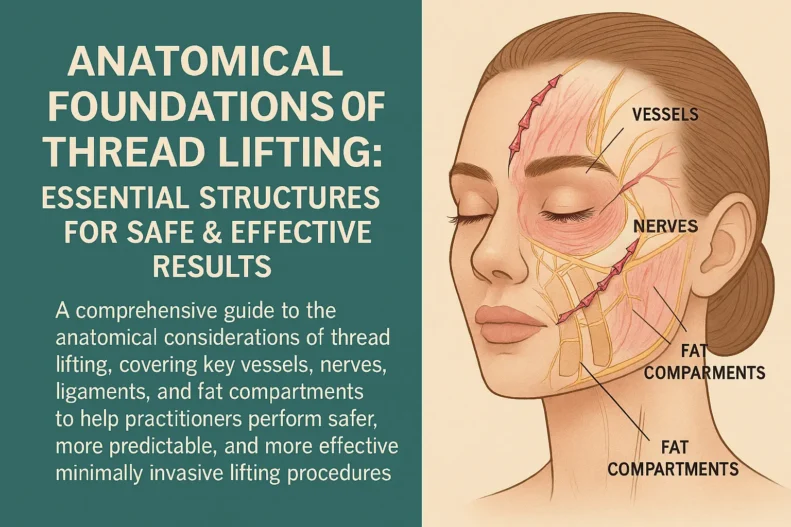
Thread lifting has rapidly become one of the most in-demand minimally invasive aesthetic procedures, offering facial rejuvenation with minimal downtime. Yet, achieving safe, predictable, and natural results relies heavily on understanding the anatomy beneath the skin. Based on advanced anatomical studies, this article breaks down the essential facial structures—vessels, nerves, ligaments, fat compartments, and glands—that directly influence the success and safety of thread lifting.
1. Understanding the Vascular Map – Preventing Bruising& Complications :
The face contains a complex network of arteries and veins that must be carefully navigated during thread lifting. The superficial temporal artery (STA) is one of the most vulnerable structures, particularly in the temple region, where thread fixation is commonly used. Variations in STA branches mean even experienced practitioners can encounter unexpected bleeding. While thin PDO threads may cause minor bruising easily controlled with compression, thicker cog threads near the SMAS have a higher risk of vessel
perforation. The facial artery—deep along the mandible and superficial near the nose and lips—requires particular caution to avoid hematoma formation during lifting.
2. Nerve Pathways – Protecting Function & Sensation:
Thread lifting with a blunt cannula generally minimizes nerve complications, but critical areas remain. The temporal branch of the facial nerve, located along the Pitanguy line, should always be approached gently. While nerve paralysis is rare, sensory disturbances around the perioral area may occur, typically resolving within one to two weeks. Maintaining precise depth control prevents unnecessary nerve irritation.
3. Retaining Ligaments – The Anchor Points of a Successful Lift:
Facial retaining ligaments are crucial structural “pillars” that define tissue support and act as natural fixation points for cog threads. The zygomatic and masseteric ligaments, forming a T-shaped structural intersection, provide stability and strong anchoring power. Using these ligamentous structures enhances lifting longevity, though excessive tension may cause dimpling—requiring immediate massage for correction.
4. Fat Compartments – Understanding Volume Loss & Descent:
Aging causes both superficial and deep fat compartments to shift and lose volume. Thread lifting primarily targets superficial fat, such as the nasolabial and jowl compartments, which are responsible for folds and facial heaviness. Since deep fat (e.g., deep medial cheek fat) decreases with age, combination therapies—such as adding fillers to restore structural support—often yield the most natural and harmonious outcomes. Jowl lifting, marionette line correction, and nasolabial fold improvement rely heavily on this anatomical approach.
5. Facial Spaces – The Safe Pathways for Cannula Movement:
Facial spaces, located between fascia layers, muscles, and fat compartments, provide relatively safe “tunnels” for cannula-based thread
insertion. Although these planes typically lack critical vessels or nerves, areas near the premasseteric space may cause discomfort during chewing or mouth opening if threads lie too close to the masseter muscle. Therefore, ideal thread placement often targets the SMAS or the superficial jowl fat rather than deep spaces.
6. Parotid & Submandibular Glands – High-Risk Areas Requiring Precision :
Accidental penetration of the parotid or submandibular glands can result in sialocele, inflammation, or prolonged swelling—making anatomical awareness essential. Since the parotid gland sits close to the SMAS and facial nerve branches, deep cannula insertion in the region should be avoided, especially during double-chin or jawline lifting.
Conclusion
Mastering facial anatomy is the cornerstone of successful thread lifting. Understanding the vascular network, nerve pathways, ligament structures, fat compartments, and gland positions not only enhances treatment outcomes but also significantly reduces the risk of complications. With precise anatomical knowledge, thread lifting becomes a safe, efficient, and transformative minimally invasive technique.